Graduate Composition & Piano Recital
February 16, 2026 | Kresge Theatre
-
“It's like Steve Reich is running a busy newsroom with Tcherepnin and Kapustin.”
“This piece feels like you're seeing vines and trees growing at 2048x speed, like it's sprouting everywhere and it's super fast, but everything has its place and it's super controlled.”
“It reminds me of New York City. Like how it can be busy, how it has moments of fascination, and also has its moments of reflection.”
“Sounds like a modern-day Charlie Brown if it had more of a watercolor visual style.”
“Like you're biting into a cool and crisp pear or apple.”
“Feels like a fish swimming against a current, taking time out at times to drift away and recuperate, only to start again.”
- YouTube comments section
Nahre Sol, known for her online videos on music theory, composition, and practice techniques, originally composed this piece in 2019 for a Yamaha CP88 synthesizer. It was the product of research she did for her video “Synthesizers, As Digested By a Classical Musician.” She later adapted it for solo piano for her album “Alice in Wonderland,” and the piece took on a new organic life and warmth offered by the acoustic instrument.
Although much of the piece borders on ludicrous rhythmic intensity, it holds together remarkably well. The harmonic and melodic motives remain fairly consistent throughout the form, and growth is achieved by minute adjustments in register and texture, a picture of Sol’s minimalist influence. It is bright, exciting, engaging, and eclectic. As is evident in the selection of comments on the piano solo version’s video, it is extremely evocative, though not restrictively so; different minds experience different imagery. And that’s art.
-
In the words of my beloved former teacher Kirk Reese, this piece represents “everything that made Bach a great keyboard composer.” The harmony is colorful, adventurous, and surprising. The piece strikes a balance between thoughtfulness, delicacy, and virtuosity in a manner characteristic of the Baroque period.
The Fantasia begins by exploring the harmonic and dramatic possibilities of a single line, which is later joined by sections of lush yet mysterious arpeggios. The drama continues as the movement unfolds into a recitative, reminiscent of the vocal style of the same name that rhythmically resembles spoken word. After a mountain range of expressive climaxes, the journey of the Fantasia then comes to a complete rest. The Fugue that follows is a monstrous undertaking of musical narrative and pianistic gymnastics, all of which come to a glorious conclusion.
I discovered this piece early in my years as an undergraduate, and it has since been a favorite piece of mine. It combines improvisatory freedom with a degree of analytical precision (though without fear of bending the so-called “rules”) that I just can’t seem to get enough of. The process of digesting this piece has been immensely challenging and gratifying. It is an honor to present this masterwork from one of the all-time greats of Western music.
-
English composer, conductor, and violist Frank Bridge occupied a musical space on the margins between Impressionism and Modernism. His career was historically situated around the First World War, which deeply affected him as a strong pacifist. Perhaps fittingly, this piece was written for his friend, the organist and pianist Douglas Fox, whose right arm was amputated during the war. The work joins the not insignificant repertoire of left-hand-only works, most famously championed by pianist Paul Wittgenstein, whose fate was the same as that of Fox.
This set became an important artistic outlet for me while I recovered from labrum repair surgery in late 2024 and 2025. Aside from the obvious technical challenges of using only one hand (my weaker and less dextrous hand, at that), the music is expressively dense and requires unwavering attention to detail. Each of the three movements presents a serious interpretive challenge, which is truly a godsend for a musician whose body is in recovery. Though my shoulder is fully healed after over a year of rehab, this piece remains an important cornerstone in my musical journey.
-
The finale of this half of the recital epitomizes the Russian late-Romantic idiom. It contrasts thick darkness with moments of hope, tenderness, and melancholy. The set of 12 was written around the turn of the 20th century as an homage to Franz Liszt’s set of Transcendental Etudes. As a result, these etudes present a formidable technical challenge. And while the physicality creates a great deal of excitement for both performer and listener, this piece also features some truly profound and expressive melodies and textures. It was this juxtaposition of athleticism and lyricism that drew me to this piece, and that makes it rewarding to both play and listen to.
-
The magnolia tree has long been a favorite tree of mine. Since the era of daily walks or runs (some know that time as the COVID lockdown), when I became suddenly aware of the plant life in my neighborhood, I have found the magnolia’s considerable trunk, smooth bark, and large, fragrant blossoms to be inexplicably comforting to me.
Curiously, the tree only stays in bloom for around two weeks out of the year (at least in my hometown). This has led to a long reflection on the poetic beauty of temporality. During my gap year before graduate school, I thought of the college friends with whom I was no longer in contact, and even moreso, the high school friends with whom I hadn’t spoken since our graduation. Were these relationships not as valuable as I once thought because they hadn’t stood the test of time? Maybe to some small degree, but I’m not convinced. The value that those relationships added to my life in their time was not erased by the discovery of their finitude, just as the beauty of a magnolia flower is not erased by the end of its short bloom.
This nocturne was born out of this reflection. In it, I attempt to capture the melancholy, nostalgia, and bittersweetness of considering times gone by. Many beautiful things must end, but their beauty need not.
-
This piece was as an anniversary present for my long-distance girlfriend, Lindsey. It was written during the short five-week reprieve from the separation that we get each summer, as our work at the Csehy Summer School of Music brings us together. This short composition captures my perception of her kindness, gentleness, and humor as of July 2025. Since then, we’ve both grown as individuals and in our understanding of one another. This evening’s performance reflects that growth, as well as the excitement and anticipation of our future opportunities to express our connection and appreciation for one another.
-
The idea for this piece was born out of an improvisation at the piano while I was bored in a practice room in the fall of 2025. The improvisation was a simple two-chord vamp (Gmaj/C to Dbmaj13, for those who care) in a bouncy syncopated rhythm. In general, these vamps are often thoughtless stims that are followed by my actual warmup routine. This particular idea, however, made the cut to be written down, and a month later, fleshed out into a chamber piece.
After developing the accompanimental figure from the original vamp, I began improvising melodies and writing down what stuck. The chord progression suggested the octatonic scale, and I loved the way the melodies flirted with blues sonorities while remaining decidedly modern. This process continued until I had a handful of tunes to work with. These tunes felt evocative of different forest creatures approaching a fallen beehive: some curious, others apprehensive, all unsure of whether the colony of bees was still active.
The piece developed into a loose rondo form, with three occurrences of the main theme alternating with two contrasting sections. When choosing material for these contrasting sections, I was delighted to discover some figures that were originally accompanimental in the A section that played nicely as new themes. The cyclical recurrence of themes is extremely compositionally satisfying to me, so I was very pleased that it seemed to happen without much effort. All of this, combined with a cheeky musical quote and five incredibly talented, kind, and hard-working musicians, made this one of the most enjoyable projects of the past year.
Program Notes:
All program notes written by Josiah.
Artist’s note
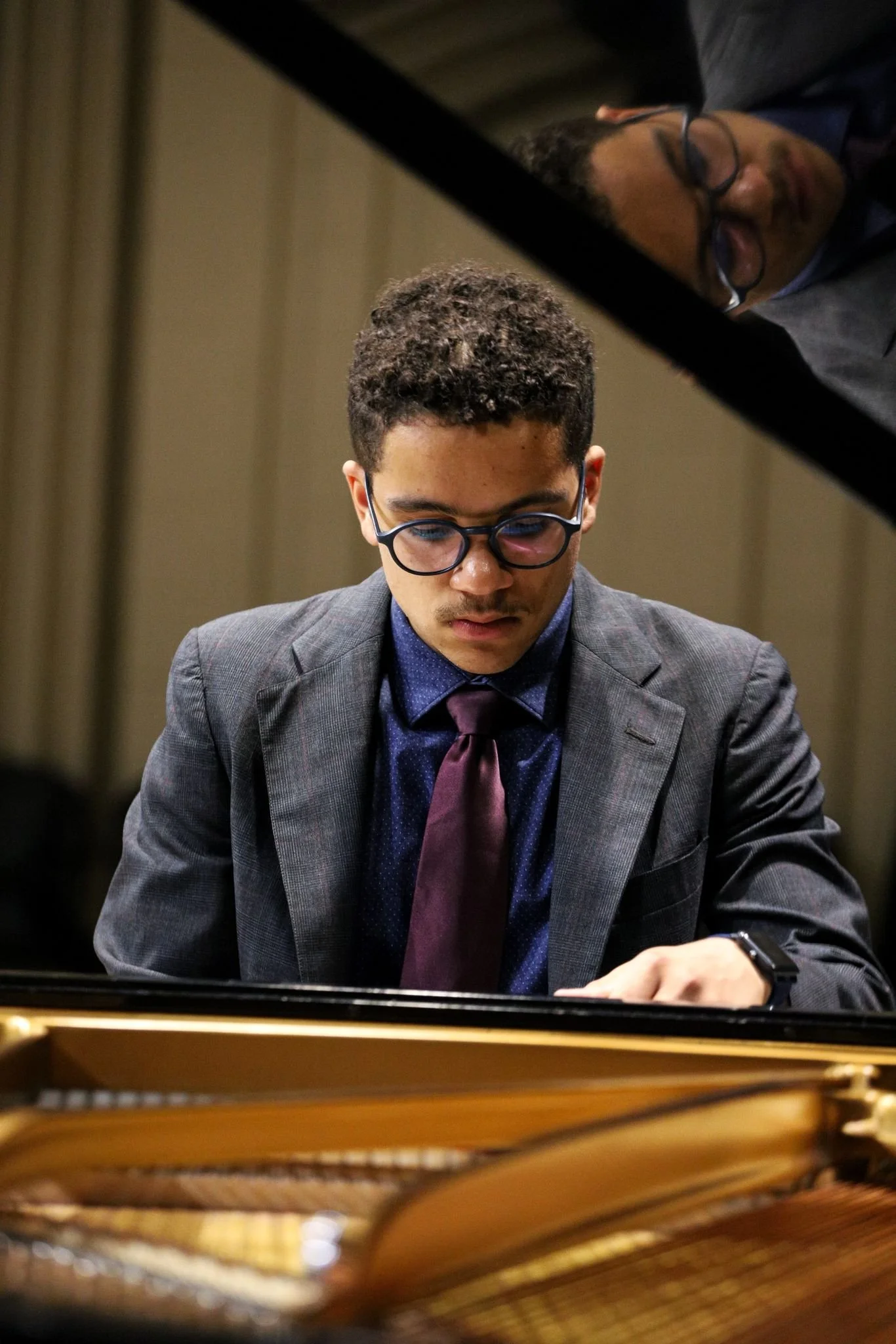
This evening is first and foremost a celebration. We celebrate healing. We celebrate progress. We celebrate the good gift of hard work. We celebrate the beautiful three-way relationship that exists between composer, performer, and audience member, each reading their own story and perspective into sound waves to create meaning. Each of these celebrations points to a good God who loves to give good gifts.
Second, this evening is a representation. A story involving a gap year, a shoulder injury, a beautiful woman, and a young musician flourishing in his new environment is entwined in this recital program. Even deeper than that, 24 years of development and growth are on display through the medium of musical creativity.
I am truly grateful to have the opportunity to share this program. This year has been a year of discovery for me as I have jumped head-first into the journey of graduate school. I have learned about myself, about the world of music, and about the God that made it all. What a privilege it is to share this gift with other people.
“Far be it from me that I should boast except in the cross of our Lord Jesus Christ, by which the world has been crucified to me, and I to the world.” Soli Deo Gloria; to God alone be the glory.
-JP
Gratitude
Many heartfelt thanks to:
Ma and Daddy, my rocks, for being my greatest and most loyal supporters;
Brendan, my ride or die, you make me better every day;
Lindsey, my heart-home, for inspiring me daily with your passion, ambition, and grace;
Provans and Meachums all around the world, for not letting distance keep us from being a family;
Prof. Galbraith, for yapping, laughing, and somehow still managing to dive deeply into all the topics and techniques I hoped to learn about while here;
Prof. Chiu, for fundamentally changing my perspective on being a musician years before I even met you, and for being even cooler in person;
Mark, Sean, and Riean, for never leaving my side, and for being my sharpening stones and loyal brothers in Christ;
Katie, for the stunning poster designs (and for teaming up with Dave to give the world the gift of Lindsey);
Intervarsity and Graduate Christian Fellowships, for being the loving and encouraging community of true friends I prayed for all summer;
The CMU Composition and Piano Studios, for being places I have felt welcomed, challenged, and motivated since day one;
James, Abby, Lexi, Joe, Rachel, and Jonathan, for being not only tremendously competent and diligent, but also exceptionally kind, fun, and easy to work with;
My in-person audience, for taking time to show up;
My online audience, for taking time to show up when being in the room isn’t feasible;
Jesus Christ, the Author of all creativity and the Standard of all beauty and meaning; music is worth the making, indeed, life is worth the living, because you live.